Vacuum coater: construction, operation, and PVD technology
An expert guide to industrial systems for depositing thin metallic coatings in high vacuum.
Modern surface engineering and the production of plastics and glass products rely on advanced PVD (Physical Vapor Deposition) processes. The device that performs these processes on an industrial scale is the vacuum coater. This article presents a detailed analysis of the construction and physicochemical principles of operation of thermal evaporation systems, which are the leading standard in the production of precision mirrors and decorative coatings.
Physics of metal evaporation in high vacuum
Depositing metallic coatings by thermal evaporation is based on the simple but technologically demanding phenomenon of changing the state of matter of a material under deep vacuum conditions. In a normal atmosphere (1013 hPa), gas molecules collide with each other continuously, and the temperature required to boil or sublimate metals is extremely high.
When the pressure inside the working chamber of the vacuum coater is lowered to a high vacuum level (typically between 10-5 and 10-6 mbar), the situation changes drastically. The number of residual gas molecules is so small that the so-called mean free path of atoms released from the evaporation source becomes larger than the distance between the evaporator and the metallized details. This means that evaporated metal atoms (e.g. pure aluminium) travel in straight lines in the chamber without colliding with air molecules, depositing directly on the surface of the parts to form a nanometer-thick coating of perfect cohesion.
Vacuum chamber shell
Water-cooled, double wall made of acid-resistant stainless steel (inox) preventing micro-outgassing.
Glow discharge electrode (Argon)
Responsible for argon ionization, glow discharge, and plasma activation of the substrate.
Rotating carousel (Carriage)
Provides continuous planetary motion (orbiting and rotating of parts) around the central metal source.
Radial stream of metal atoms
Collision-free flight of aluminium atoms in vacuum and their uniform condensation on details.
Central resistive evaporator
Tungsten heating element that melts aluminium wire using high-amperage current.
High vacuum connection
Outlet connected to backing pumps and diffusion pump responsible for gas evacuation.
Chamber and vacuum pump system construction
The working chamber of the vacuum coater must withstand huge mechanical forces resulting from the pressure difference. It is constructed of high-grade acid-resistant stainless steel (inox), which features a minimal microporosities coefficient and does not emit residual gases (wall outgassing phenomenon).
The pumping system is a complex, three-stage system designed to quickly and stably lower the chamber pressure:
- Rough vacuum: Obtained by rotary mechanical (vane) pumps that operate from atmospheric pressure and bring the chamber down to the low vacuum range.
- Medium vacuum: Assisted by Roots pumps (Roots blowers), which feature enormous volumetric efficiency in the medium pressure range and shorten the pumping transition time.
- High vacuum: Obtained by high-performance diffusion (oil) or turbomolecular pumps. These pumps remove remaining gas molecules at the molecular level, allowing stable metal evaporation without oxide formation.
Substrate activation – the role of glow discharge (Glow Discharge)
Even the most precisely vaporized metal will peel off if the part's surface is not optimally prepared. For this purpose, industrial coaters are equipped with glow discharge (Glow Discharge) systems. Before starting the evaporation process, a small, controlled amount of working gas (usually argon) is introduced into the chamber, and a high voltage of several thousand volts is applied.
This leads to ionization of the gas and plasma generation. The accelerated ions bombard the surface of the parts placed in the chamber, removing organic contaminants and moisture and activating the polymer surface (creating free radicals). This increases the surface energy of the base material, guaranteeing excellent adhesion of the deposited nanometer aluminum film.
Advantages of thermal evaporation in industrial applications
Thermal resistance evaporation technology is widely used due to its efficiency and reproducibility. In resistive evaporators, tungsten boats or spirals are powered by high current (often hundreds of amperes at low voltage), causing them to immediately heat up to temperatures exceeding the melting and vaporization point of the aluminum suspended on them. This method allows for:
- Obtaining perfect chemical purity of the deposited layer, translating into excellent optical properties (high gloss and reflectivity of mirrors up to 92-95%).
- Elimination of internal stresses in the coating, which prevents it from cracking and tarnishing during the use of finished products.
- No harmful liquid waste, which qualifies this method as a highly ecological industrial technology (Green Technology).
Industrial Vacuum Coater KOLZER DGK36 (Year 2020)
Complete thermal vacuum metallisation system in perfect technical condition
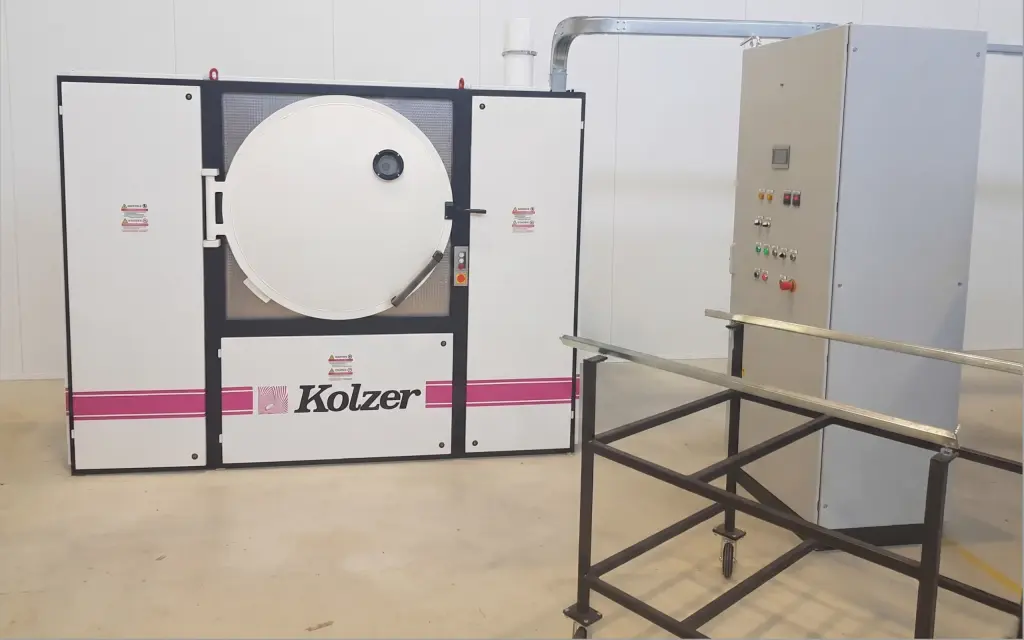
- Manufacturer: KOLZER (Italy)
- Year of manufacture: 2020
- Usage: approx. 1,000 operating hours
- Technology: Resistive evaporation
- Working carousel: ø 1000 mm x 1300 mm
- Condition: Excellent, operational (Skoczów, Poland)
Related Articles
- How does PVD vacuum metallisation work? Step-by-step process
- Vacuum metallisation: benefits and applications in industry
- KOLZER DGK36 vacuum coater — details of the sales offer
If you have questions about vacuum deposition technology, are looking for a PVD metallisation service, or are interested in purchasing the KOLZER DGK36 coater — contact us. The ELMAL Sp. z o.o. team will gladly answer all technical questions.